The Performer's Role

In our cultural moment, there is a growing expectation that performers must personally affirm every idea contained within the works they perform. Before a note is played, we ask: Do you agree with this? Does this represent your beliefs? Are you endorsing it by standing on the stage?

But art has never worked that way. To perform a work is not always to confess allegiance to it.

This matters deeply because music is one of the last remaining places where human beings can still sit inside perspectives different from their own without immediately deciding whether they approve or disapprove of them. This is a place where empathy can be born. The performer’s role has traditionally been larger and more generous than mere self expression. The performer becomes, in a sense, a host. They open the door. They prepare the table. They allow the work to speak.

To perform a work about sexuality, suffering, war, doubt, faith, or longing is not necessarily to declare agreement with every idea within it. Sometimes it is simply to say: This exists in the human experience. Listen.

Music has always wrestled with belief, doubt, politics, grief, faith, identity, protest, longing, and transcendence. Sacred masses. Spirituals. Revolutionary songs. Anti war works. If performers may only engage works that perfectly mirror their own convictions, then art slowly collapses inward until it can no longer encounter anything beyond the self. The repertoire narrows. Curiosity dies. The artist becomes trapped inside a hall of mirrors, only encountering echoes of themselves.

There is, of course, a difference between performance and compelled confession. Conscience matters. No person should be compelled to make personal declarations against their beliefs. But performing or encountering a work is not the same thing as agreeing with it. To stand inside a work for a moment is not always to surrender oneself to it. Sometimes it is an act of listening. Sometimes it is hospitality. Sometimes it is simply the recognition that another human being’s experience, however distant from your own, is part of the human story.

Audiences are capable of discernment. They can wrestle with what they hear. They can accept it, reject it, question it, or be transformed by it. That responsibility belongs to them.

The performer’s task is more humble and more profound.

To offer the work.

To let the listener encounter it freely.

The Blank Page

It always starts with a low-grade panic.

You sit down to write, which already feels heroic, and within about twelve seconds your brain suggests that this would be an excellent time to reorganize your closet, deep clean the kitchen, or finally become the kind of person who stretches every morning. You suddenly care very much about things you have ignored for months. You think, maybe I should learn to bake bread. Maybe I should text everyone I have ever known.

Anything, really. Anything except starting this piece.

Because starting means you might discover that you cannot do it.

You have done it before. You have written music. Entire pieces. People may have even liked them. But your mind does not bring that up. Your mind says, Yes, but what if that was a fluke. What if that was your last good idea and now you are just a person with fancy, expensive pencils and delusions.

So you stall.

You make coffee. Then you look up ways to improve the coffee on your phone. Then you drink the coffee while standing in the kitchen staring at nothing, as if an idea might float down from the ceiling if you remain very still and slightly miserable.

Then you go on a walk. Not a refreshing, invigorating walk. The kind where you shuffle around your neighborhood thinking about all the people who are probably being productive right now. You look at trees like they might have answers. They do not. They are just trees, being very unhelpful.

Eventually, you come back, which feels like a personal failure.

You sit down again, and now there is this moment where you realize no one is coming to save you. There is no magical beginning waiting to be discovered. There is just the blank page and your deep reluctance to ruin it.

Because that is the other part. The page is perfect right now. Untouched. Innocent. Beautifully pure. The second you write something, it will be less perfect. Possibly much less.

So you hover.

And then, because time passes and you are still there, you write something small. A phrase.  A fragment. Something that does not feel important or impressive or even particularly good. It might, in fact, feel like proof that you were right to be afraid.

But now there is something on the page.

And then, briefly, something strange happens. You write a little more. Eight measures, maybe. And for one fleeting, unreasonable moment, you think, Well. This is obviously important. This is the kind of thing people will sit very still for. You become, temporarily, a person who has a process.

The next day you open the file and feel betrayed. Not by anyone else, but by Yesterday You, who apparently had no standards. The melody sounds cliche. The harmony feels like it read about emotion in a book once. You listen through and experience all five stages of grief in under three minutes.

You consider deleting everything. You hover over “select all” like it is a red button in a movie that will save the world if pressed. You do not press it, mostly because you are tired and also because you have already told someone you are “working on something.”

So you adjust one note. Then another. You move a line down an octave, which feels productive. You rename the file something hopeful like “sketch 3 revised FINAL,” which is a lie.

Some days, a door opens. A chord lands in a way that feels honest, and suddenly you remember why you started. You sit up straighter. You forgive the piece for its earlier behavior. You even forgive yourself. You actually go to the gym again and smile at people.

Other days, it is deeply uncooperative. You snack more than is medically advisable. You Google entirely new career paths. You briefly wonder if silence might have been your true medium all along.

This becomes the rhythm. Write a little. Doubt a lot. Walk. Rename the file again. Return.

More becomes something. Slowly. Quietly.

The fear does not go away. It just stops being the only voice in the room. There is now this other, smaller voice that says, Well, maybe keep going. Not because it is going well. But because it has, at least, begun. You can always abandon it later.

And that is the whole terrible miracle of it.

You do not wait until you feel ready. You do not wait until you feel gifted or inspired or confident or like a person who has any business doing this.

You begin while afraid.

You continue while unconvinced.

And somehow, despite all of this, the piece comes into being. Not all at once. Not cleanly. But stubbornly. Phrase by phrase. Note by note.

You reach the end almost by accident.

You are not convinced it is perfect. You are fairly sure it is not.

But it is finished.

And that, which once felt impossible, now feels like grace.

First Reading

Handing a new piece to a conductor feels a little like handing someone your journal and trying to act normal about it.

You want to say, “Oh this? It’s nothing,” while also wanting them to understand everything. Every late night you couldn’t sleep thinking about it, every moment you thought you had something true and then immediately doubted it. You want them to hear what you meant, not just what you wrote, which, as it turns out, are not always the same thing.

There is a very specific anxiety that shows up right before the first rehearsal. It is not dramatic. It is quiet and persistent, like a small dog that will not stop following you around the house. (I know a bit about that.)  And in this case, you are not even in the room. You have sent the files. You have done your part. You have said, “Let me know if you have any questions,” which is code for please tell me everything is okay but also do not tell me anything is wrong.

You are at home. Waiting.

This is where things get strange.

Because when you are not there, your imagination fills the room for you. Not in a helpful way. In your version, you messed it all up. The balance is off. Someone stops and says, “What is this supposed to be?” The conductor frowns slightly. People are polite, but there is a feeling.

You try to distract yourself. You answer emails. You fold laundry. You dust your studio…because you know, that helps you compose better for the next one. You check your phone every few minutes for a message that has not arrived. You tell yourself that no news is good news, which is comforting for about thirty seconds.

Then the other thoughts come in.

Maybe it is too complicated. Maybe it is too simple. Maybe that section you believed in does not actually work. Maybe you should have rewritten the ending. Maybe the whole thing needed another month. Or six. Because when you were writing, it felt alive in a protected way. You could adjust things. You could believe with a bit more effort you could make it work. You could trust that the pacing made sense because you felt it. There is a lot of faith involved. Possibly a little denial.

Now, somewhere else, real people are going to find out if that was true.

And this is the moment where your brain becomes deeply unhelpful. It offers you a steady stream of certainty about things it cannot possibly know. They hate it. They are confused. You have ruined everything. You will never work again.

These thoughts are not useful. They are also very convincing.

Meanwhile, something else is happening.

The music is becoming real. It is no longer just yours. Other people are holding it now, sometimes a little awkwardly, like passing a fragile bowl around a table. The conductor might stop and adjust something. A player might ask a question that reveals where you were not as clear as you thought. Or they might understand something instinctively that you did not even know you had written.

You are not there to hear it, which somehow makes it both worse… and better.

Eventually, something breaks the silence. A message comes in. Or enough time passes that you realize the world has not ended. Maybe the conductor writes, “Great first read today,” which you will analyze like it is a coded message. What does “great” mean? What does “first read” mean? Is there something they are not saying?

Or maybe they ask a question. And strangely, this is a relief. Because now the piece has edges. It has met reality. But yes…you still reached for that chocolate when you saw the question mark on the text.

If you can soften, even a little, you begin to see what is actually happening. This is not a verdict. It is a beginning. The piece is meeting other people. It is being shaped, clarified, sometimes misunderstood, and sometimes unexpectedly brought to life in ways you could not have predicted.

Somewhere, in a room you are not in, someone is playing your notes. Breathing them. Trying to make sense of them. And even if it is imperfect, it is real.

You are still a little fragile. Probably more than a little.

But you are no longer alone with it.

The piece has entered the world, imperfect and breathing, and somehow that is both terrifying and exactly what you were hoping for all along.

Divine Dissatisfaction

In 1943, after the unexpected success of Oklahoma!, Agnes de Mille found herself disoriented. The works she believed were fine had been ignored. The one she thought merely fair was celebrated. Over a soda at Schrafft’s, she confessed to Martha Graham that she had a burning desire to be excellent but no faith that she could be.

Grahm’s response has become a great artistic manifesto:

Martha said to me, very quietly: “There is a vitality, a life force, an energy, a quickening that is translated through you into action, and because there is only one of you in all of time, this expression is unique. And if you block it, it will never exist through any other medium and it will be lost. The world will not have it. It is not your business to determine how good it is nor how valuable nor how it compares with other expressions. It is your business to keep it yours clearly and directly, to keep the channel open. You do not even have to believe in yourself or your work. You have to keep yourself open and aware to the urges that motivate you. Keep the channel open. As for you, Agnes, you have so far used about one-third of your talent.”

“But,” I said, “when I see my work I take for granted what other people value in it. I see only its ineptitude, inorganic flaws, and crudities. I am not pleased or satisfied.”

“No artist is pleased.”

“But then there is no satisfaction?”

“No satisfaction whatever at any time,” she cried out passionately. “There is only a divine dissatisfaction, a blessed unrest that keeps us marching and makes us more alive than the others.”

Years later, Zadie smith would write in her essay “Fail Better” that you must “resign yourself to the lifelong sadness that comes from never being satisfied.”

At first glance, these statements seem hopeless. Divine dissatisfaction. Lifelong sadness. I must confess…life as a composer does feel that way.

Yet, both statements are strangely consoling.

The ache to be better doesn’t go away. Success does not cure it. Praise does not quiet it. If anything, the better you become, the more aware you are of all the ways you have fallen short.

Graham frames it as vocation. There is something that can only come through you. Your task is stewardship, not self-evaluation.

Smith frames it as realism. The gap between vision and execution never fully closes.

Paul writes something oddly similar in 1 Corinthians 4:3-4:

“It is a very small thing that I should be judged by you or by any human court. In fact, I do not even judge myself…”

Taken together, these things are evidence you are an artist. The unrest keeps you motivated. The sadness keeps you honest. Ultimately, it is not about you.

December 2025

What I am working on:

I am in the final stages of a new piece for the Arkansas Intercollegiate Band. The piece will be performed February 20, 2026 at the Arkansas All-State Music Conference. I also have a piece in progress for the City of Fairfax Band which will be premiered in 2026.

Midwest Clinic:

Booth #1917

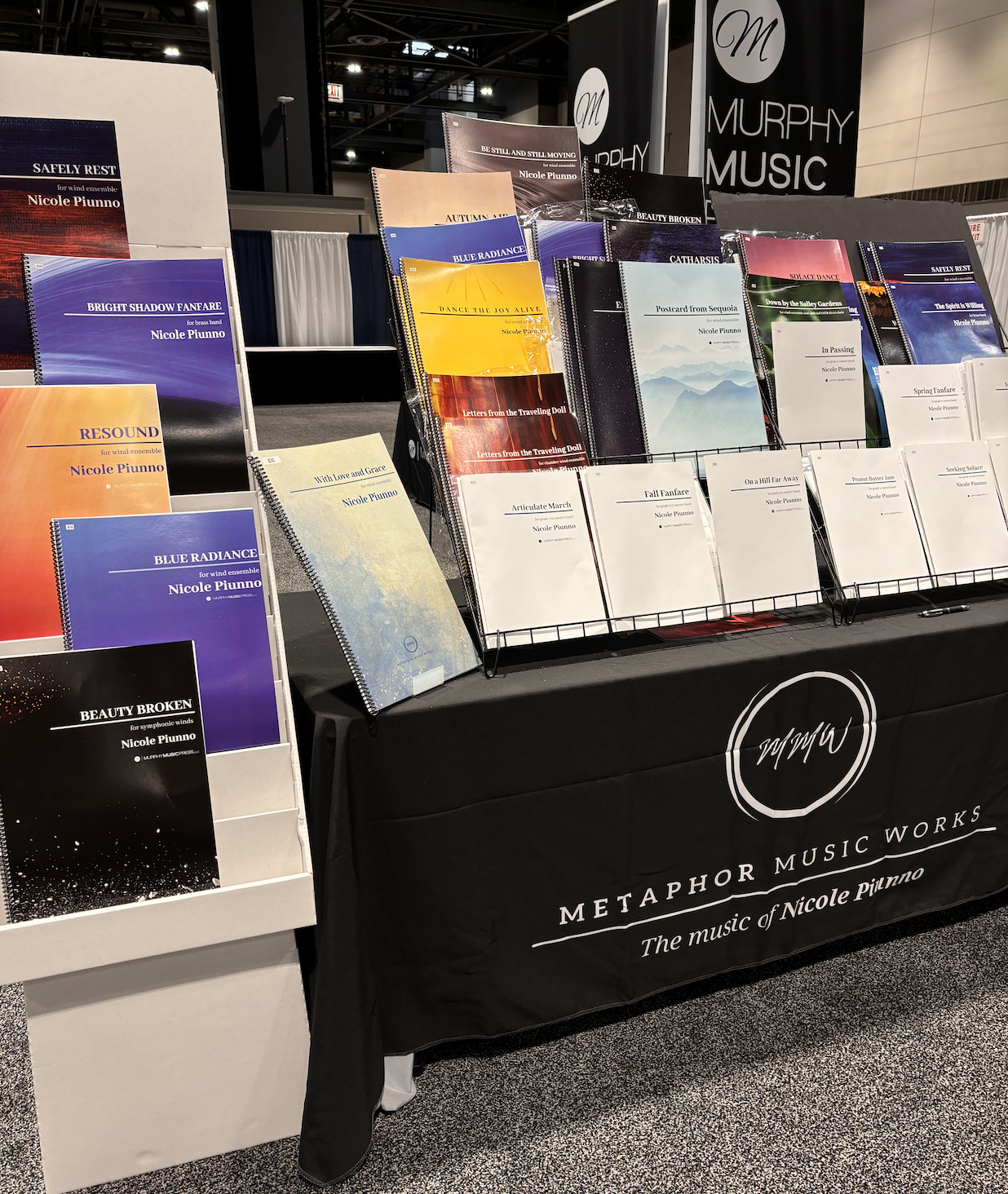
I’ll be exhibiting with Aaron Perrine again this year. We are with Murphy Music Press at booth 1917.


Bright Shadow Fanfare will be performed by the Desert Winds on Friday 12/19 at 8:30AM in room W375AB.

There will also be a meet and greet with my composer friends Aaron Perrine, James David, and Pete Meechan Wednesday 12/17 at 5:30pm.

What I’m looking forward to:

I have a few ideas for some larger works and am looking for people to collaborate with on these. I am backing away from certain types of work in order to make space and writing time for these projects. Hopefully more to come on this later.

New Recordings I’ve found of my work that I love:

Simplicity

“Simplicity is the final achievement. …it is simplicity that emerges as the crowing reward of art.”

Quote attributed to Chopin.

Simplicity is the most refined state. After exploring all the musical possibilities while writing a piece, the composer returns to the most essential. A piece reveals it’s true self when it is stripped of ego and excess.

With artistic maturity comes the realization that expressiveness, clarity of orchestration, and emotional depth are not dependent on complexity or flash. The pursuit of “newer, faster, higher” eventually becomes dull. True mastery is the ability to say something profound without all the extra noise. This is economy of means…where one chooses every note with extreme intentionality. It’s the wisdom to remove anything that doesn’t serve the heart of the piece.

New Releases Summer 2025

Frostfire is a grade 1 work with pro-level trumpet soloist. The piece was designed to help students get excited about what their instrument is capable of as they advance in school and perhaps inspire them to take lessons. Check out the recording here

Radiant Glory is a grade 3 concert march for wind ensemble that intertwines two contrasting yet complementary tunes: “Hamburg” and “Salve Festa Dies.” The tune “Hamburg” has a chant-like quality, evoking a sense of love and sacrifice. In contrast, “Salve Festa Dies” brings a vibrant and celebratory energy to the piece. Together, these melodies create a narrative that captures the essence of a radiant spirit and celebrates the triumph of light over darkness.

The piece was written in memory of Rochelle Carroll

Check out recording and perusal here

Van Gogh's Lullaby

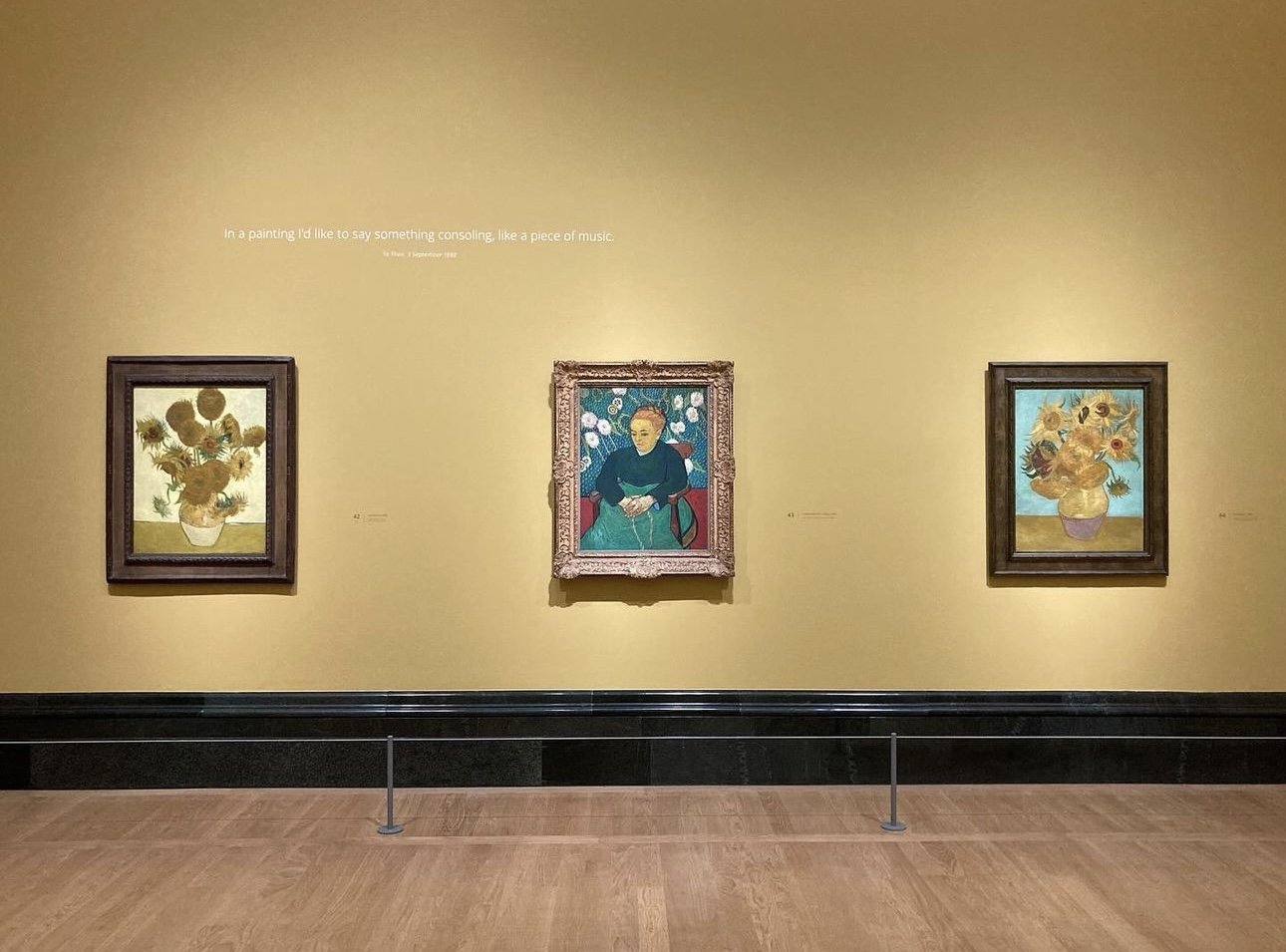
The National Gallery in London just made one of Van Gogh’s dreams a reality 134 years after his death. They put this triptych together with Van Gogh’s Sunflowers on each side of a painting of “La Berceuse” (The Lullaby) and have it on display from now until December. The Lullaby painting consists of a woman holding a rope that would be used to rock a cradle with a baby.

Van Gogh wrote in his letters that he’d like one sunflower painting with a yellow background and one with a blue background on each side of “The Lullaby” because he considered it the ultimate way his work could give comfort. This is the first time these paintings have been displayed in the way he truly wanted.

When I first learned about this wish of his through reading these letters, it influenced my approach to how I was writing my piece Sunflower Studies. I knew I wanted to put melodies that would sound lullaby-like in nature throughout the piece. I’m happy to see he got his wish.

Sunflower Studies Update

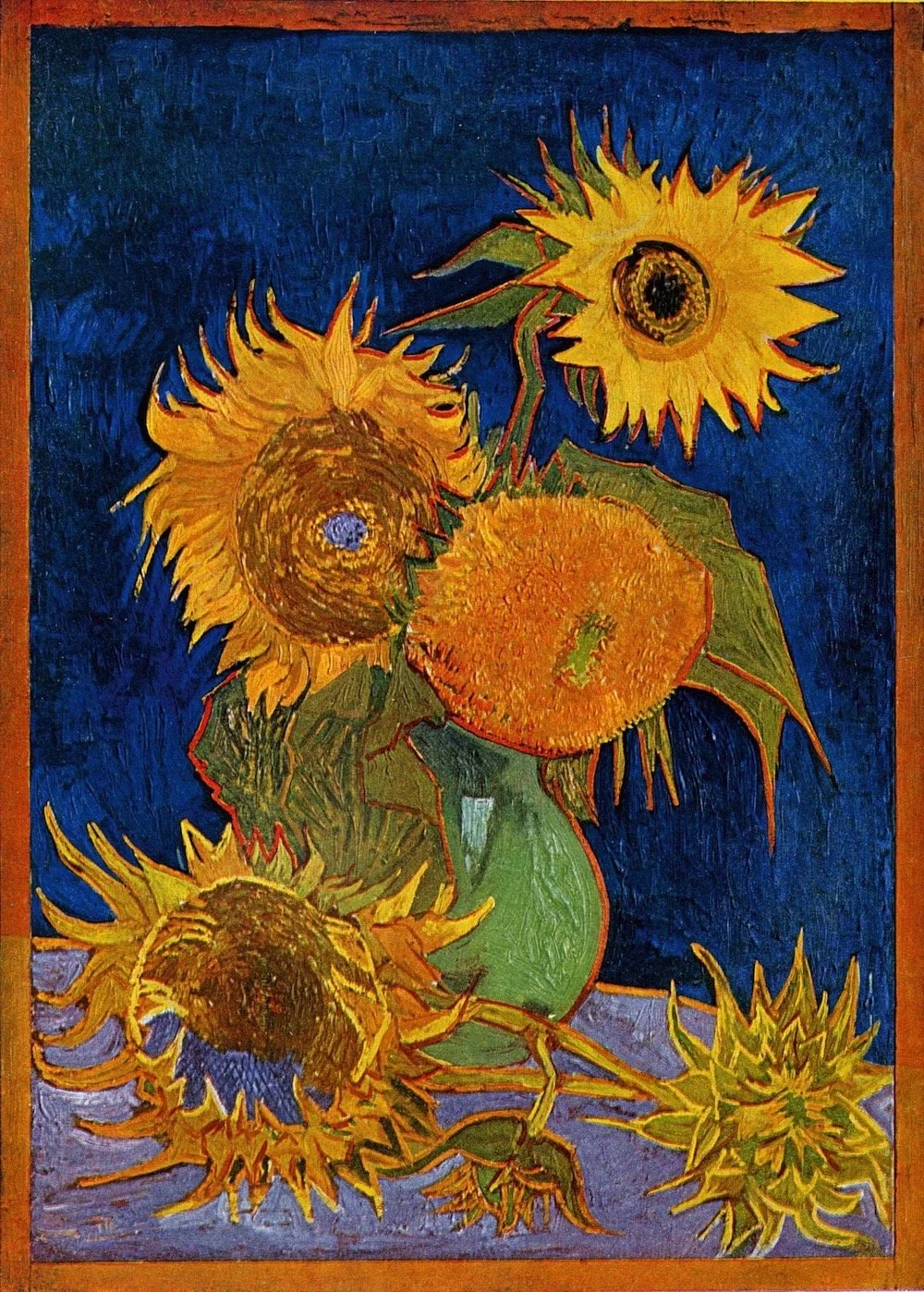
Vincent wrote that his Arles sunflowers were ‘almost a cry of anguish’, while also symbolizing gratitude. Anguish and gratitude. Two things we don’t always think go hand in hand, but perhaps they do? My fourth movement addresses this idea the most. Perhaps the more inner anguish one feels the more one tends to seek beauty. This movement will likely be the one I consider the cornerstone of the whole piece. It portrays the beauty, resiliency, and boldness of the sunflower. These are the qualities I believe make the flower such a great metaphor for faith itself. And perhaps these qualities are why Van Gogh thought sunflowers symbolized gratitude.

News Post

What’s new from Metaphor Music Works?

  • Safely Rest will be performed at the 2022 Midwest Clinic by the Mason Wind Symphony.

  • Safely Rest is now on the OMEA 2022-2023 required state music list.

  • At a Crossroads for percussion ensemble was recently written and delivered to the Texas Christian University Percussion Orchestra for their performance at Pasic in November.

What are some new releases?

Two new chamber music pieces are now available:

What am I working on now?

  • Sunflower Studies (a symphony for wind ensemble) is still in the works! To join the consortium. More info here.

  • Down by the Salley Gardens for combined wind ensemble and choir (Grade 3). This piece will be premiered at the Scioto County Honors Music Festival in February 2023.


Everything Band Podcast

Thank you to Mark Connor for the opportunity to speak on his Everything Band Podcast. It’s a great podcast to hear from various composers, conductors and educators. It was nice to share some aspects of my story and be able to give credit to some key people in my life. I don’t know where I’d be if it were not for people like David Gillingham, David Ludwig and Jim Gray. Music is so important and for some reason it seems to be one of the best vehicles to bring out community and encouragement in people. Such a wonderful thing!

Link:

http://directory.libsyn.com/episode/index/id/6879209/tdest_id/500284

I will lament and love

I said these words almost two years ago (video below). I had no idea just how tightly I'd have to hold on to these very beliefs in order to write the piece I just finished.  I said those words before my piece, Eternity in an Hour, was performed.  However, these words are even more applicable to the piece I just wrote that is in response to what happened at Stoneman Douglas High School, titled I will lament and love. The piece is a lament, but also a display of hope.  I've included 17 short solos throughout the work to draw attention to the individuals who lost their lives.  

When you sing through suffering (whether through the human voice or giving voice to an instrument through human breath), that means hope is alive.  A lament can hold the saddest melody, but if that melody is sung then hope is present. 

I was approached in February about writing this piece and we are at the end of that process. The Ohio State University Wind Symphony generously recorded the piece as soon as I finished the work.  I am so glad to have been a part of such a thoughtful process.


Upcoming Performances

6 wind ensemble performances coming up!

February 11th- Capital University will premiere "Solace Dance"

March 3rd-Columbia University gives the US premiere of "Beauty Broken"

March 5th- Rowan University will premiere "Autumn Air".

April 23rd- Arizona State University concert band will perform "Dance the Joy Alive".  Winner of composition contest for the Arizona State University concert band which was held by the Beta Omicron Chapter of Kappa Kappa Psi.